
Short answer: Cat5e and Cat6 are excellent for IP data, but the Velbus bus isn’t high speed IP data. Velbus and other non-IP systems carry both power and data on the same four-core cable, so the size of the copper inside decides whether modules at the far end get enough voltage.
Bottom line is always, “Use the right cable for the job.”
For Velbus, a KNX-style cable at around 0.8mm per core is a professional choice, and here’s why:
- Cat6 only delivers 10Gb up to roughly 37 to 55 metres. At 100 metres it runs the same 1Gb as Cat5e.
- A Velbus bus carries +15V, 0V, CAN high and CAN low at 16.6kbps, so voltage drop matters more.
- Choosing the right cable (for any task) is about topology, copper size, screening and jacket rating, not just the numbers on the sleeve.
- Don’t take anyone’s word for it, including mine. Test it hands-on first.
Cat5e & Cat6 are brilliant at what they were made for
If you’re moving IP data around a building (media files, cameras, access points, a network rack), it does the job beautifully.
But the speed printed on the sleeve isn’t the whole story. Cat6 only carries 10Gb over short runs, roughly 37 to 55 metres, depending on how noisy the environment is.
Over a full 100-metre run it gives you the same 1Gb as Cat5e.
Cat6A is the cable built for 10Gb at 100 metres, and it’s thicker, heavier and costly.
Does CCTV specifically need Cat6?
I get asked this a lot. IP cameras are usually fed over Cat5e or Cat6, often with power over the same cable (PoE). But very few IP cameras use gigabit connections, and Cat5e is easily capable of the required 100Mb throughput. Most IP camera systems use less than 100Mbps even at high resolution.
So Cat6 brings no bandwidth benefit to a camera. It can help in awkward, noisy routes, but it’s also often thicker and less flexible in tight spaces.
A properly terminated FTP Cat5e cable would resolve these issues.
That said, even with PoE cameras, cable resistance affects the power that reaches the camera. Hold that thought, because it’s the key to everything below.
A bus is a different animal
A Velbus bus isn’t carrying IP traffic. Its data runs CANbus at 16.6kbps, a tiny fraction of what Cat6 can move, so speed isn’t the problem we’re addressing.
What the cable does carry is power. There are four conductors:
- +15V (red), nominally 15V with a 3V tolerance
- 0V (black), the power return and the data ground reference
- CAN high (yellow)
- CAN low (white)
The data travels as a differential pair measured against the 0V line. You can watch it happen in our bus concept animation.
Every metre of cable has resistance. When relays switch and panels light, current flows and the voltage drops along the run. The thinner the conductor, the bigger the drop. It’s a general rule of CAN wiring too: CAN cable guidance asks for an adequate conductor size and says the voltage drop must be taken into account.
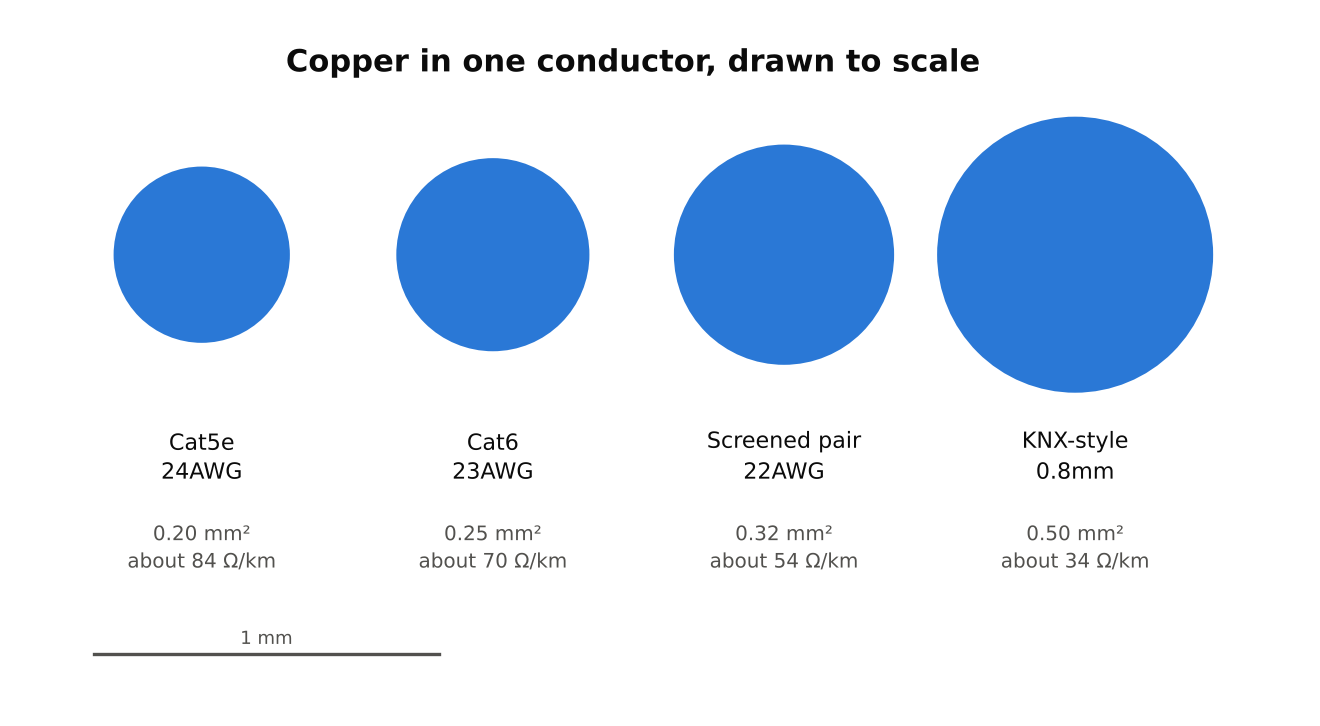
Cat5e and Cat6 conductors are fairly slim, roughly 0.2 to 0.25mm² of copper per conductor (typically 24AWG for Cat5e, 23AWG for many Cat6). KNX-style cable at about 0.8mm per core has roughly double that, so it holds its voltage much further.
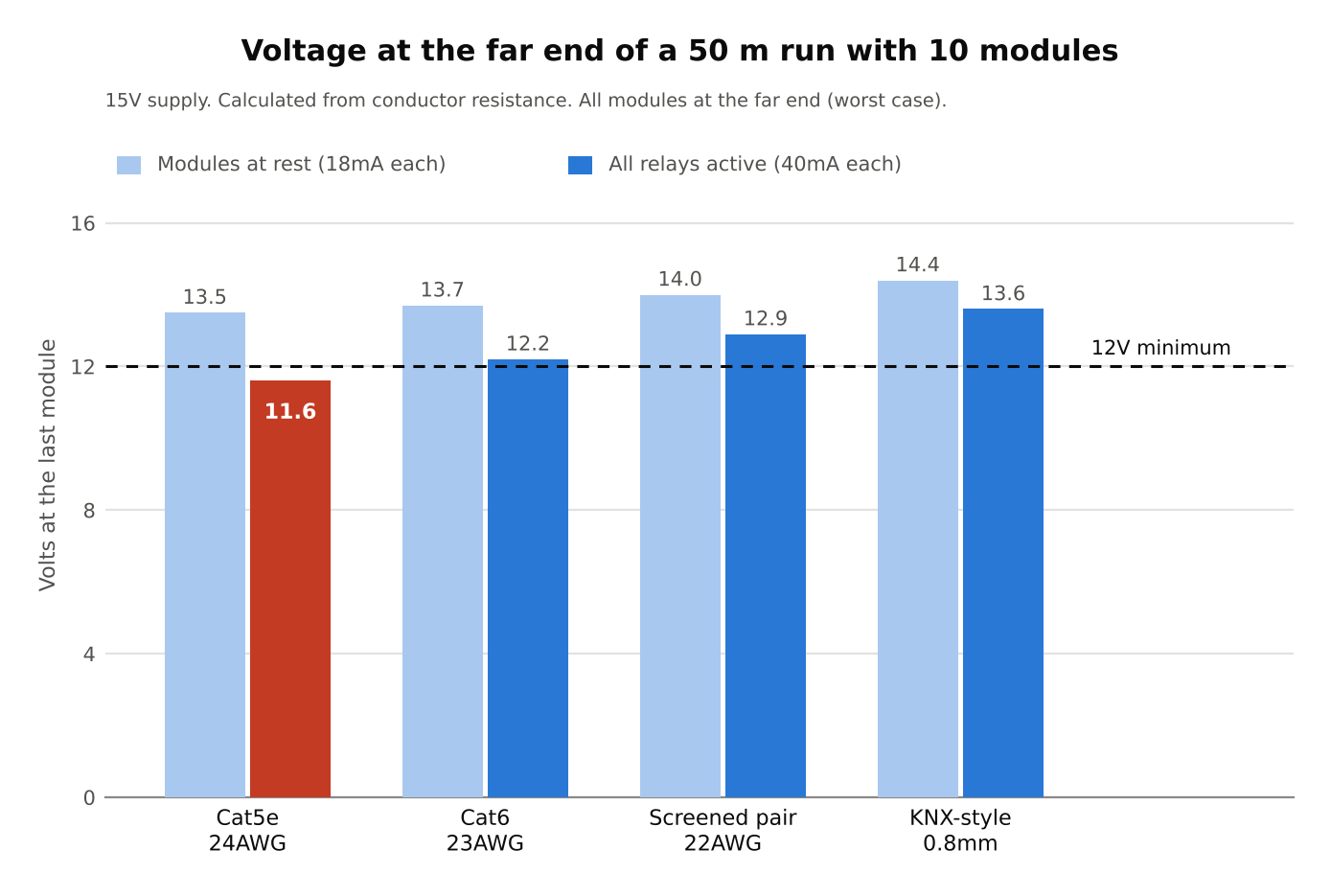
Here’s what that looks like on a real bus. Take 10 modules at the far end of a 50 metre run, using the rule of thumb of 18mA per module at rest and up to 40mA when relays are active. The supply starts at 15V, and the bus needs to stay above 12V.
| Cable | Copper per conductor | Resistance per conductor (Ω/km) | Far-end voltage, modules at rest (180mA) | Far-end voltage, all relays active (400mA) |
|---|---|---|---|---|
| Cat5e, 24AWG | about 0.20mm² | about 84 | 13.5V | 11.6V |
| Cat6, 23AWG | about 0.25mm² | about 70 | 13.7V | 12.2V |
| Screened pair, 22AWG | 0.32mm² | about 54 | 14.0V | 12.9V |
| KNX-style, 0.8mm | about 0.50mm² | about 34 | 14.4V | 13.6V |
These are calculated figures, using copper resistance at 20°C, one conductor each for +15V and 0V, and all the modules at the far end. Real buses spread their modules along the run, so treat this as the worst case.
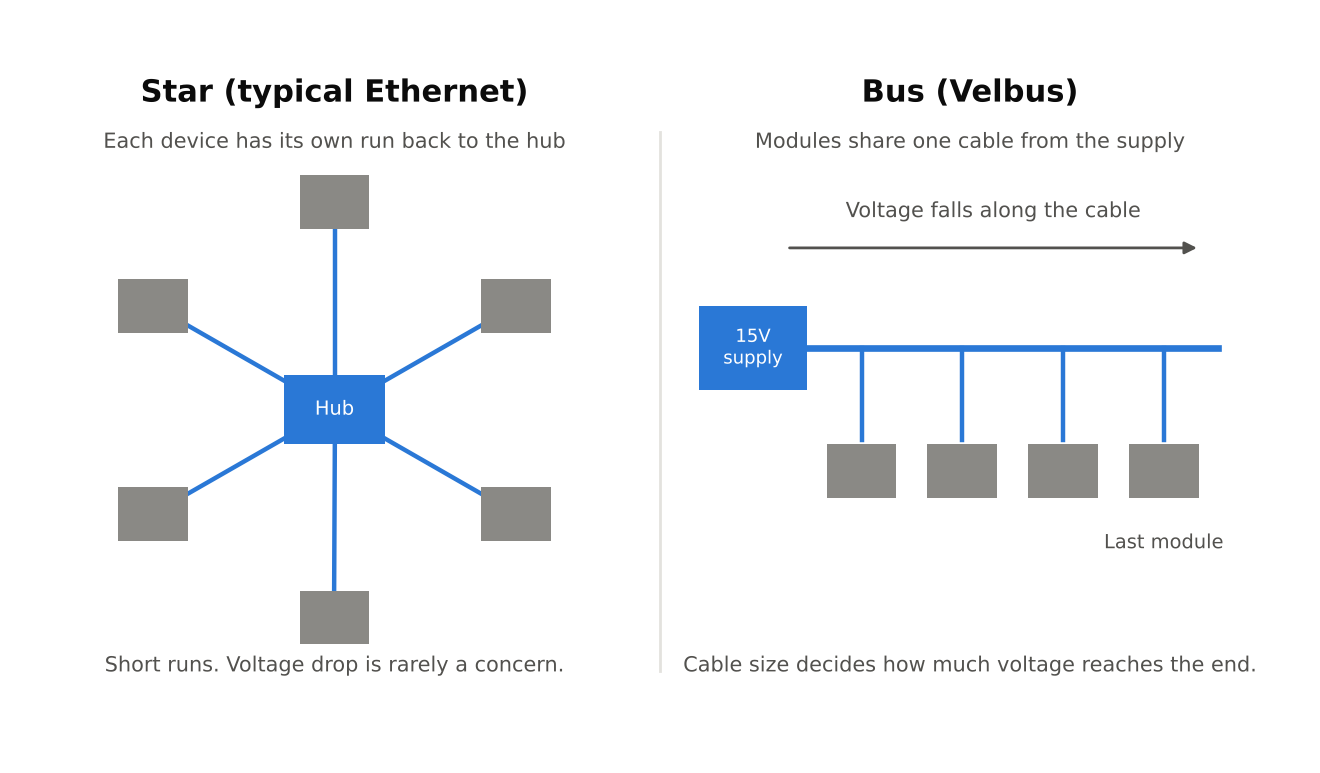
The other difference is layout.
Ethernet is usually a star: every device has its own short run back to a hub.
A bus is a chain, and the last module can be a long way from the power supply.
A true story: wrong cable for the topology
Early on, when I was a lot less fastidious than I am now, I advised an installer to use CANbus cable. Instead of asking what that meant, they used cheaper and thinner Cat5, because that’s what the other systems they’d installed used.
The catch is that those other systems were wired as a star or hub-and-spoke, rather than as a bus or ring.
The Velbus data worked everywhere. However, at the rear of the property the bus voltage would drop below 12V whenever multiple relays were active, and the modules there failed in ways that looked mysterious. (Technically they didn’t “fail”. They detected the low bus voltage and rolled back to a safe state, even giving status feedback via their onboard LEDs, in the way of a Triple Flash, indicating “Low Bus Voltage”.)
Splitting the +ve line and back-feeding 15V into half the property from a second power supply at the rear fixed it. That’s an authorised way of powering larger networks.
Bigger projects avoid the problem by design. Each floor gets its own cabinet and 15V supply, and the cabinets are linked by only three conductors: 0V (the data reference), CAN high and CAN low.
Nobody in that story did anything unreasonable. They used what they knew.
That’s the lesson: habit is a poor substitute for knowledge, and not asking “why” has far reaching consequences.
So what should installers use?
For Velbus, a cable that meets the EIB/KNX standard is perfect. At about 0.8mm per core it delivers good voltage over long distances. In theory, with very few modules drawing current, the first and last module could be more than 1,500 metres apart, though in practice that’s very unusual.
Our wiring topologies drawing shows the options, and this supplier lists a Velbus lighting and HVAC control cable if you want an example.
Sometimes a building makes big cables awkward to route. On rare occasions I’ve elected to use a thinner screened twin twisted pair (22AWG, 0.32mm²).
As I did with an episode of #DIYSOS, where I predicted that there might be some tight spaces to work around. See the full episode on iPlayer: https://www.bbc.co.uk/programmes/m0032l3x
A thinner cable works if you respect its limits: shorter runs, fewer glass panels on each run to make up for the voltage loss, and real care at first fix, because the thinner jacket is fragile.
Handling matters on any cable. A thick jacket forgives heavy hands, but a harsh kink has already damaged the copper inside. Straightening the outside doesn’t repair it.
And don’t stop at size and colour. A cable’s jacket rating decides whether the regulations let it share containment (trays, baskets) with other cables, but it says nothing about electromagnetic interference.
That’s the job of the screen and drain wire inside, and I’ll cover it in a follow-up.
Questions to ask your electrician, plumber, HVAC engineer, blind fitter or system designer
If you’re not the one pulling the cable, these questions help you check that someone knows rather than guesses:
- Is this a star or a bus system, and does the cable suit that layout?
- What cable does the manufacturer specify, and why?
- What voltage will the furthest module see with every relay switched on?
- Where are the power supplies, and does each floor have its own?
- Who has handled and routed the cable, and has everyone ensured ZERO kinks or pinches? (This applies to ALL cable types, not just data, although it is especially important for data cable types.)
- Has anyone on site got previous system experience or attended a training session?
Don’t take my word for it
The best way to judge any system is to put your hands on the hardware before you commit your money, your time, your professionalism and your methods.
Test it for yourself, don’t proceed purely on someone else’s say-so, unless they can evidence their experience and knowledge.
I’ve trained over 3,000 UK students and installers in the five years to June 2026.
In the UK we don’t have a fixed training building, so we rent spaces wherever groups ask for training. Our head office in Belgium has a demo room and training area that anyone is welcome to visit. Come and see it working for yourself.
FAQ
Can I use Cat5e or Cat6 for Velbus?
We don’t recommend it. Cat5e and Cat6 are great data cables, but a Velbus bus also carries power, and slim conductors make voltage drop more likely on longer runs.
In my experience the data can keep working while modules at the far end fall back to a safe state.
What is the best cable for Velbus?
Cable that meets the EIB/KNX standard, at around 0.8mm per core.
What’s the difference between star and bus wiring?
In a star format, every device has its own run back to a central point. In a bus, devices are chained along one cable, so voltage drop builds up towards the end.
Can a Velbus system have more than one power supply? Yes. Larger buildings often use one 15V supply per floor, with the floors linked by only 0V, CAN high and CAN low.